
Printed circuit heat exchangers
Los circuitos impresos del intercambiador de calor (PCHE) de Alfa Laval combinan una robustez y una integridad superiores con una tasa de transferencia de calor muy alta, en una unidad que es hasta un 85 % más pequeña y liviana que los intercambiadores de tubo y carcasa comparables. El diseño exclusivo da como resultado un excelente rendimiento, menores costes de instalación y operación, y una mayor seguridad. Cada unidad también es totalmente personalizable de acuerdo a sus necesidades exactas.
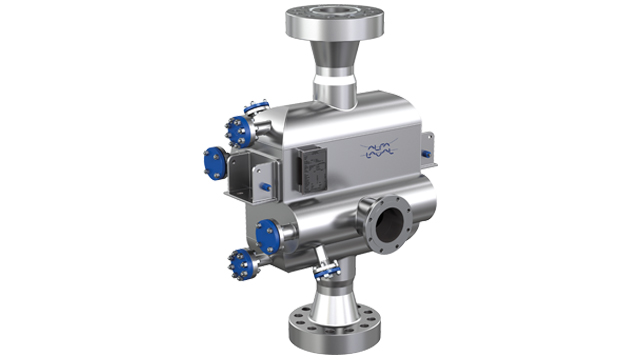
Eficiencia de primera clase con la menor necesidad de espacio posible
- Construcción totalmente de acero inoxidable, totalmente personalizable para adaptarse a la posición de trabajo y a la aplicación requerida
- El diseño robusto maneja presiones de hasta 1000 barg (14 500 psi) y temperaturas que van desde -196 °C (-320 °F) a 800 °C (1472 °F)
- Permite temperaturas de aproximación de 1 °C dentro de su proceso.
- Inmune a los efectos de las pulsaciones de presión del fluido y la vibración inducida por el flujo de fluido
- Cumple con el Código ASME para calderas y recipientes a presión (sección VIII, división 1 con marca de certificación U) y Marcado CE (PED 2014/68/UE)
Applications
Alfa Laval printed circuit heat exchangers are designed specifically to deliver unparalleled compactness and efficiency in clean and high-pressure duties that are beyond the capability of other welded plate type heat exchangers. The robust design can reliably handle pressures ranging from full vacuum to 1,250 bar (18,125 psi).
Typical marine applications include high-pressure vaporization in fuel gas supply systems (FGSS), LNG regasification on FSRU and SRV™ vessels. In the energy sector, printed circuit exchangers are used in gas processing and cryogenic LNG applications. Typically, these are gas compression systems offshore, hydrocarbon gas and water dew-pointing. In LNG, where high energy recovery is desired, they are used in End Flash Gas and BOG handling systems. They can also be found in turbine fuel gas preheating and supercritical carbon dioxide (sCO2) applications for power generation.
In renewable energy applications PCHEs are proving to be a great technology fit in high-temperature long duration energy storage (LDES) processes, as well as evolving niche positions in carbon capture.
Combining the proven advantages of our classic PCHE design with our 3DPlate™ anti-freezing technology also opens up use across the whole hydrogen refuelling station energy chain from liquid to gas. In hydrogen refuelling stations, Alfa Laval PCHEs are an ideal solution for precooling of hydrogen, offering possibilities to reduce filling times and wait times between refuels, while minimizing installation costs.
Technical data
Design pressure
EN/CE/PED Vacuum to 1,250 barg (18,125 psig)
ASME Vacuum to 1,250 barg (18,125 psig)
Design temperature
316/316L SST –196°C (cryogenic) to 800 °C (–321°F to 1,472 °F)
Connections
Customizable from small tube to large pipes (¼ to 30)
Standard materials
304L or 316L SST (other materials available on request)
Dimensions/Weights
On request, tailored towards requirements ranging from a few kilograms to tens of tons
Cómo funciona
Working principle
Printed circuit heat exchangers operate with two or more media on opposite sides of a diffusion welded plate. It is possible to have high-pressure flows on both sides, and a 2D or 3D plate pattern can be optimized to provide the required thermal length and pressure drop.
Design
The printed circuit heat exchanger design has a complex flow pattern chemically etched on flat sheets of material. This flow pattern is optimized for each specific customer duty to provide the required thermal and hydraulic characteristics. Each flow circuit plate pattern can be different, giving the possibility of asymmetric flows and optimized 2-phase behaviour.
The individual plates are then stacked into a block and diffusion welded (bonded) in a state-of-the art furnace at high temperature and pressure. Multiple blocks can be welded together to create the required thermal capacity or heat transfer area. Inlet and outlet flow manifolds, customer connections and (if required) connections for drain, vent or cleaning form the welded header assemblies, which are welded onto the completed core to finalize the heat exchanger.
Design pressures of up to 1,250 bar (18,125 psi) in 304/316 stainless steel are achievable with this configuration.
Heat transfer surface areas are tailored based on requirements.
Unique features that make the difference
Alfa Laval has more than 80 years’ experience in heat transfer technology, and we are continuously developing new innovations to improve the performance, reliability and sustainable impact of our equipment. Our printed circuit heat exchangers include a number of unique features you won’t find anywhere else:
 OptiBond™
A robust and compact solution for high-pressure needs
State-of-the-art diffusion welding (bonding) technology provides the highest durability and thermal efficiency within an ultra-compact welded plate heat exchanger.
 3DPlate™
Prevents clogging under freezing conditions
A patented 3D plate pattern maintains high efficiency and maximum uptime when using water-based fluids like glycols in cryogenic applications.